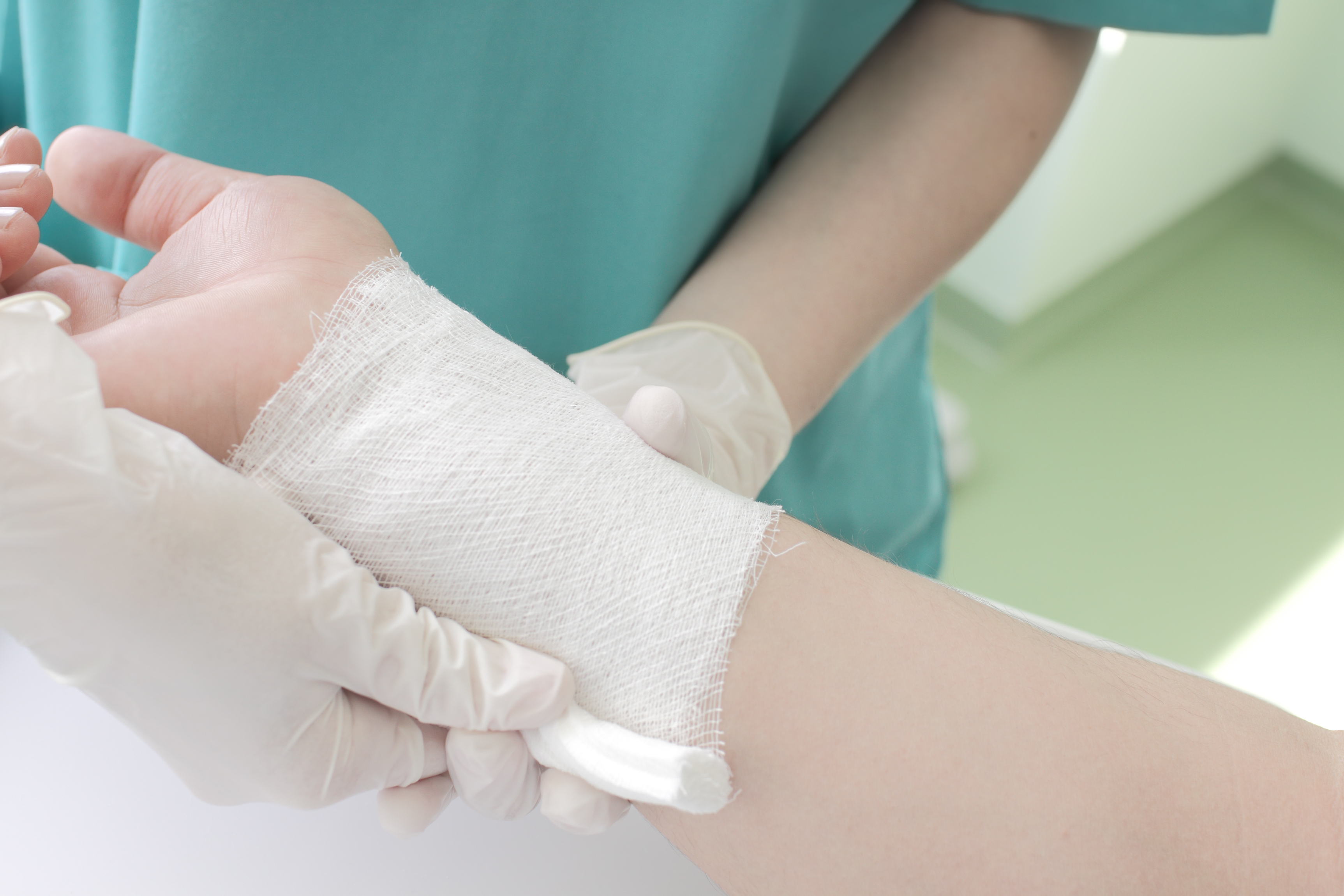
Treating wounds and giving patients the best chance at recovery
By: Michele Charlton
From minor cuts and scrapes to chronic ulcers, pressure injuries and surgical incisions, the proper treatment of wounds not only reduces pain and discomfort for patients but helps them heal faster.
Nova Scotia Health’s focus is on delivering the best possible treatment for wounds and helping to prevent them for occurring in the first place. This includes working with world-class experts who are providing additional insight and knowledge in wound treatment. Among those experts are Dr. Keith Harding, a key opinion leader, pioneering educator and clinical practitioner with 40 years’ experience in wound treatment; Dr. Karen Cross, CEO of Mimosa Diagnostics and Innovator in Residence at the Nova Scotia Health Innovation Hub and Plastic Surgeon at the QEII; and Douglas Queen, a global wound treatment consultant with over 35 years of international expertise in commercial development, market access and med-tech research & development.
We recently had the opportunity to sit down with Dr. Harding, Dr. Cross and Dr. Queen to learn more about the how wound treatment has evolved, get perspective on what it might look like going forward, and what inspires them each day.
How have wounds traditionally been treated, and how have you seen that change over the course of your careers?
Dr. Harding: One of the most interesting and fascinating changes is that we now have data that shows how common wound healing problems are, how expensive they are, and the poor quality of care that many patients receive.
In the beginning, there was a thought that letting the wound dry out and form a scab was best. Then, in the 1960s, there was a big advance when laboratory research showed that you can increase the rate of healing by keeping the wound moist and preventing it forming a scab. This was also more acceptable to the patient because it didn't hurt, sting, or stick. Since that time, there's been an explosion of interest in wound healing for topical treatments – including dressings and devices.
More recently, there's been greater realization that surgery has a role to play, in terms of improving blood supply, getting skin cover, maximizing mobility and reducing the risk of a recurrent wound.
And when COVID came from nowhere, and just shut everything down, we observed the role of caregivers, because they were the only way patients could get help. Nobody could get into hospitals; we couldn't go into the homes. It was surprising to me, how many of the patients were able to find an informal network, who could do something that was helpful. And I think that that's another development.
However, we still don’t have a comprehensive global system that all patients are plugged into, and where groups of clinicians, academic researchers, and interested health systems can collaborate with one another, and provide some focus and innovative thinking to how treatment is approached.
Why hasn’t there been lot of focus on the treatment and prevention of wounds until recent years?
Dr. Harding: There’s a famous quote that says, ‘he dressed the wound, but God healed it’. It was one of those things that became folklore - wounds would heal if you left them alone.
We've gotten much better at saving lives and stopping death by infection. But what we haven't done is focus on diseases that we now see, which have become very prevalent – like diabetic foot disease, pressure ulcers, or underlying disease. And we need to recognize that we are seeing increasingly challenging chronic wounds, which are never going to be solved by a single intervention. It's about a comprehensive assessment, and diagnosis of factors that may be influencing the wound.
Dr. Cross: When we classify wounds, we’ve always thought of them in terms of what layer of the skin has been injured. But these are physiologic wounds, which means they're dynamic - they're changing day to day or month to month. I think we need to also shift how we look at what's wrong with the wound. We need to actually look at what's wrong in that moment, knowing that that wound next week could have something different that it needs. And I think the shift that's starting to happen in this space. And not just in the wound itself, but with the patient, on a systemic level.
Dr. Harding: We're trying to fix a clinical problem - it needs to be more precise. Wounds are not the same, and they don’t all have the same factors that are preventing healing. So therefore, they're not going to all respond to the same intervention. It’s all about selecting the right intervention for the individual patient, to give them the best chance of healing.
Dr. Queen: Being in the clinic is a valuable way to help scientists, technologists and other staff focus on why their work has importance with regards to human need. I made sure that all of our development staff spent time in clinics, so that they clearly understood the patient needs and build them into the products they were trying to develop and support. They need to know where and who they would have been used on. And that really changed things.
What has inspired you?
Dr. Cross: I had a family member in rural Newfoundland, who had a wound. And then I realized, wow, this is how it really works for the patients. When I was practicing in Toronto as a surgeon, and when I had my academic lab, I thought I really understood the problem for the patients, and that I was doing a great job. Then I started to understand how people experienced this as a family. And that really shifted my thought process around how to solve the problems.
I think the way I've approached it really has come from many sides - as a surgeon, as a scientist, and now also as a family who lost a loved one related to an injury. The reason that I gave up my breast cancer practice, and my trauma practice and everything for these patients, is they're so vulnerable, and nobody's speaking for them. And it was that chance to be that advocate, and not just treat the wound, but the whole patient.
I think as a doctor, that's what I like the best about it, is that it isn’t just cut and dry, and we really have to think it through. That's why I continue to do it at full volume.
Dr. Harding: I worked for a professor I had great admiration for, and asked if I could run the wound clinic he set up. And then for two years, I ran it on a voluntary basis, one session a week and then two sessions a week, when we became a senior partner in family medicine.
I was more fascinated about wound healing and research academic work than I was on just crunching through hundreds of patients a day or a week. And my fascination has continued to carry on over the years to solving this very common and very challenging clinical problem.
Dr. Queen: When I started my PhD in biomedical engineering, I had to choose a research project. At the same time, the wife of one of my friends had been badly burned during a fireworks explosion, and after six weeks, she unfortunately passed away. She had a horrendous time during that short period.
One of the projects that was listed was to look at the development of laboratory-based tests that could screen burn wound dressings preclinically - so that you could screen them before and only take the useful ones.
I never wanted to be a bench scientist, I always knew I wanted to do some applied science and potentially move into the commercial world. But the one thing that certainly drove me the most was, ‘if there’s anything I can do in respect to my science or research to help another human being, I will’.
